The possibility of South Korea's military involvement in the Strait of Hormuz or the war in Ukraine has continued to dominate the political arena, with ranking government officials stressing again that any decision would follow legal procedures and social consensus.
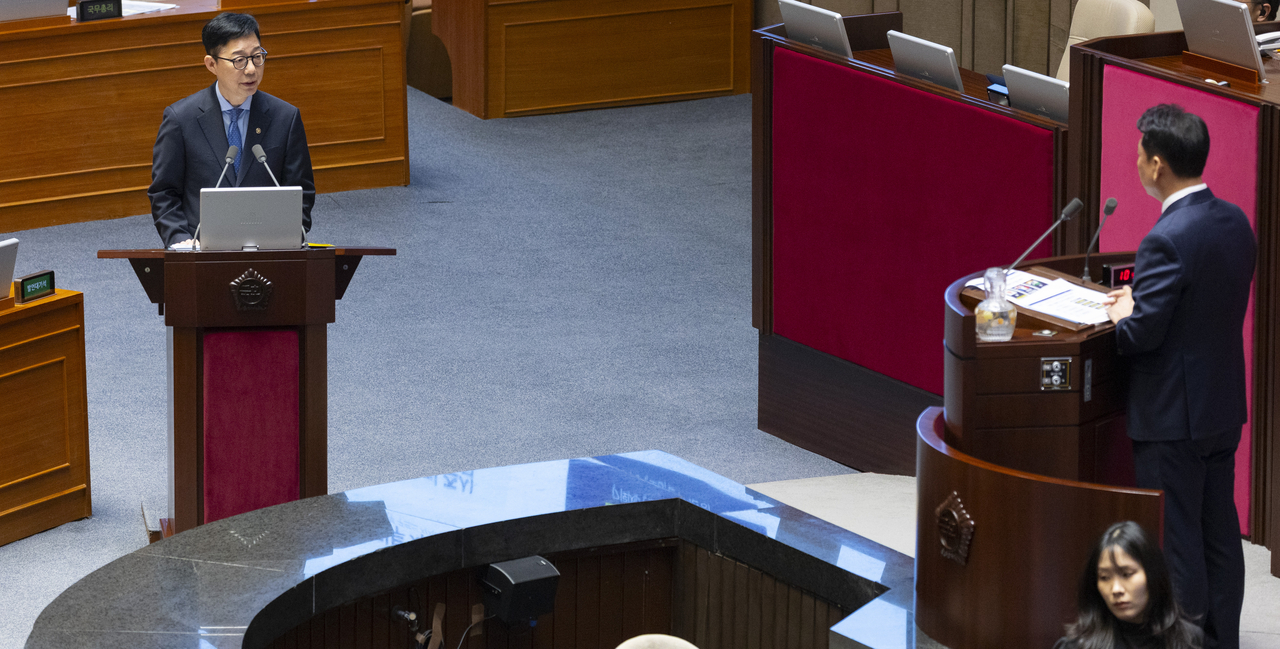
Prime Minister Han Seong-sook on Thursday reiterated Seoul's stance that no decision has been made and various options for how to contribute to freedom of navigation in the Strait of Hormuz are on the table.
"There are numerous factors to consider, so nothing concrete has been decided yet as we are currently reviewing various scenarios," Han said at the interpellation session in response to an inquiry by Democratic Party of Korea Rep. Kim Byung-joo, a four-star general-turned-lawmaker who called the US-Iran conflict "an unjust war."
Park Yoon-joo, first vice minister of the Ministry of Foreign Affairs, also said he "believed that both domestic legal procedures and social consensus must be taken into account," in response to Democratic Party Rep. Lee Kwang-jae's question as to whether Seoul was aware that any decision to deploy military forces to a foreign country would require the Assembly's consent.
Local media reports have suggested that Seoul was weighing deployment of military forces, amid pressure from US President Donald Trump to contribute to ensure security and freedom of navigation in the strait as the US-Iran conflict showed little sign of abating.
Trump also recently shared a column calling on Washington to pressure South Korea to sell Cheongung-II missile defense system to Ukraine in a recent social media post.
In response to questions on these issues, Han again stressed that there are procedures in place the government must follow.
"Regarding either arms exports or troop deployments, there are complex procedural requirements, such as securing the National Assembly's opinion and public consensus," Han said.
Asked how things are different between the 2003 deployment to Iraq and now, Park said, "troop deployment has not yet been finalized, so it is hard to draw relevant comparisons." But Park added that "The current situation in the Strait of Hormuz is fundamentally linked to our supply chains and is closely tied to the safety of vessels and South Korean people in the region."
South Korea's Constitution stipulates that the country "shall endeavor to maintain international peace and shall renounce all aggressive wars." The Constitution also states that the National Assembly has the right to consent to the deployment of armed forces. At least a majority of votes are required to gain consent.
Asked whether Seoul and Tokyo were discussing Washington's deployment requests, Park said, "Rather than discussing the deployment of troops itself with Japan, we are currently at the stage of gauging the trends of the discussions taking place within Japan."
Seoul was coordinating with Tokyo to address the supply chain disruption posed by the conflict in the Middle East, according to Park. "We are pursuing a two-track dialogue covering both the issue of exchanging stockpiles and the matter of securing energy supplies," he said.
This marked the second day of the interpellation session of the National Assembly, which is scheduled to run through Monday.
consnow@heraldcorp.com